Man Caught Riding Killer Whale in Flooded City Street: The Viral Video That Fooled the World

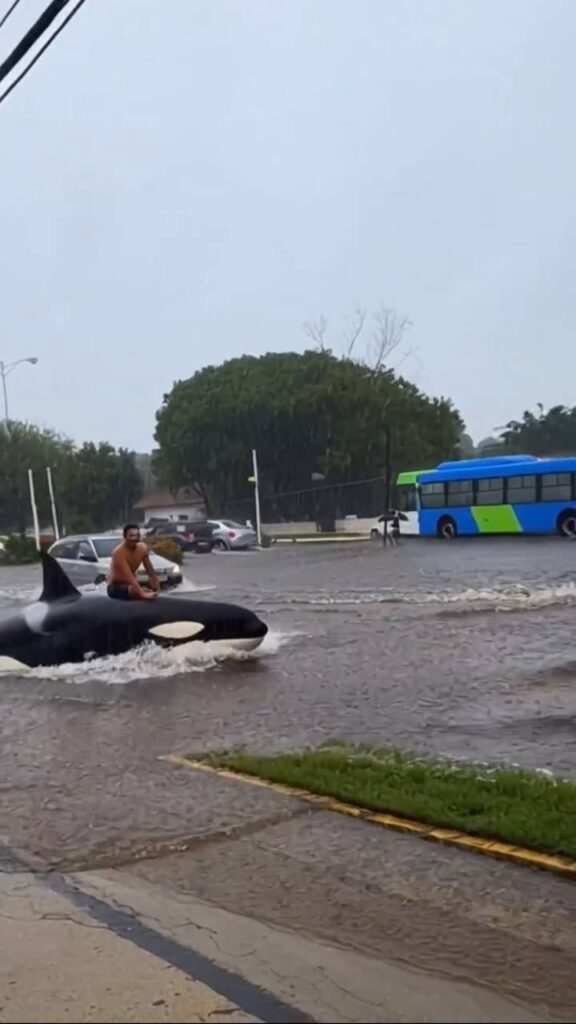
When natural disasters strike, the images are usually tragic: submerged cars, damaged homes, and rising waters. But recently, a video emerged from a flooded city that didn’t just shock viewers—it made them question their own eyes.
Amidst the chaos of a submerged downtown street, with cars bobbing like corks in the murky water, a figure appeared. It wasn’t a rescue boat. It wasn’t a jet ski.
It was a shirtless man riding a massive Killer Whale, holding onto its dorsal fin and waving his hand like a cowboy at a rodeo.
The video exploded online, racking up millions of views in hours. But how did an apex predator end up in a city street? And how was a man surviving a ride on its back? The unbelievable truth behind this footage reveals less about marine biology and more about the terrifying future of technology.
The Scene: A Surreal Rodeo in the Flood
The footage is cinematic. The water is brown and churning. The street signs are barely visible above the waterline. In the center of the frame, the black-and-white giant breaches the surface.
The man on its back looks triumphant, gripping the slick skin of the Orca as it cuts through the floodwaters. The bystanders in the video (if they are real) seem to be pointing and screaming.
It is the ultimate “man vs. nature” moment. It looks gritty, grainy, and incredibly realistic.
The Unbelievable Truth: Why It Isn’t Real
As much as we want to believe in the “Aquaman of the Floods,” the truth is that this event never happened.
The video is a prime example of high-end VFX (Visual Effects) or AI Generation.
Here is how we know the “truth” is digital:
- Biological Impossibility: Killer Whales (Orcas) are oceanic creatures. They require deep, saline water to survive. A flooded city street is shallow, filled with fresh water (rain), and clogged with debris that would beach a whale instantly.
- The Dorsal Fin Physics: An Orca’s dorsal fin is made of cartilage, not bone. It cannot support the weight of a grown man swinging from it like a rodeo bull without bending or collapsing.
- The “Uncanny Valley”: Upon closer inspection, the water interaction around the man’s legs often blurs—a hallmark of AI generation or green-screen compositing.
The “unbelievable” part isn’t the whale; it’s the fact that CGI technology has become so advanced that it can convince millions of people that a 6-ton marine mammal is commuting down Main Street.
Health & Well-Being Angle: The Real Dangers of Floodwaters
While the whale might be fake, the floodwaters in the video represent a very real danger. The video glamorizes entering floodwaters, but doing so is a massive health risk.
1. The “Toxic Soup” Effect Floodwater isn’t just rain. It is a mixture of raw sewage, spilled gasoline, industrial chemicals, and sharp debris. “Riding” anything in a flood exposes you to E. coli, Salmonella, and tetanus.
2. Hidden Hazards You cannot see what is under the surface. Manhole covers often pop off during floods due to pressure. A person wading (or falling off a fake whale) can be sucked into a storm drain instantly.
3. Digital Mental Health Viral hoaxes like this play on our anxiety and curiosity. Constantly trying to decipher what is real and what is fake on social media creates “information fatigue,” a genuine stressor in the modern digital age.
Conclusion
The video of the man riding the Killer Whale is a masterpiece of digital art, but a fabrication of reality. It captures our imagination because it combines two of our primal fears: deep water and apex predators.
While we can enjoy the creativity, it serves as a reminder to question what we see on our screens. The next time you see something “impossible” happening in a viral video, remember: if it looks too wild to be true, it’s probably rendered on a computer.
Stay safe, stay dry, and keep the whale riding for the movies.
FAQ: Viral Flood Videos
1. Can Killer Whales swim in fresh water? Technically, they can survive in fresh water for a very short time, but they cannot live in it. The lack of buoyancy and salinity would eventually kill them.
2. How was this video made? It was likely created using AI video generators (like Sora or Runway) or by a skilled VFX artist using 3D modeling software to composite a CGI whale into real flood footage.
3. Why is swimming in floodwater dangerous? Aside from drowning, the water is often electrically charged (from downed power lines) and full of bacteria from overflowing sewage systems.
4. Are there any real animals found in floods? Yes. In areas like Florida or Australia, floods often displace alligators, snakes, and spiders, bringing them into contact with humans. But never Orcas.