That Ice Looked Impossible
You watched the video. And something felt off.
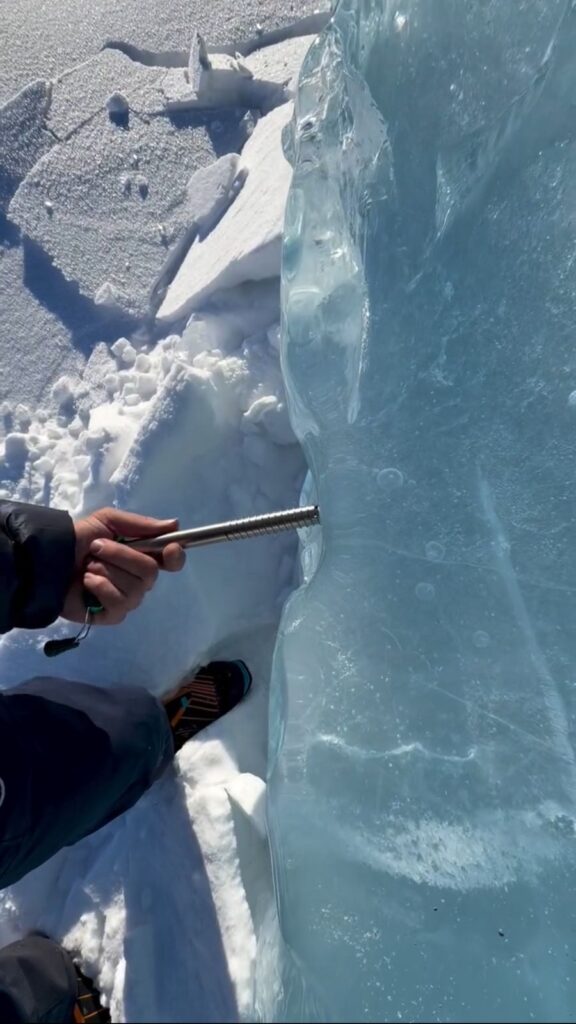
A person twisted a metal screw into a massive block of ice — but the ice didn’t look like ice. It looked like solid glass. Crystal clear. Light blue. So transparent you could watch the entire screw disappear inch by inch into the frozen block.
Your first thought? This has to be fake.
It wasn’t.
What you witnessed is one of nature’s rarest formations: perfectly clear natural ice. And understanding how it forms reveals something fascinating about physics, pressure, and the hidden chaos trapped inside every ice cube in your freezer.
Why Most Ice Is Cloudy (And This Ice Wasn’t)
Here’s a question you’ve probably never asked: why is the ice in your freezer white and foggy?
The answer is trapped air.
When water freezes quickly — like in your freezer — it solidifies from all directions at once. This rapid freezing traps dissolved gases, microscopic air bubbles, and tiny impurities inside the structure. Those bubbles scatter light, creating the cloudy, opaque appearance we associate with “normal” ice.
But clear ice formation works differently.
When water freezes extremely slowly — and crucially, from only one direction — something remarkable happens. The advancing ice front pushes air bubbles and impurities ahead of it instead of trapping them. The result is ice with almost zero internal defects.
Pure. Dense. Transparent.
This is exactly what happens in glaciers, where immense pressure and decades of slow compression squeeze out every last air pocket. It’s also what happens in certain lakes under perfect conditions — still water, consistent cold temperatures, and time.
The ice block in that viral clear ice video? Almost certainly glacial ice or ice harvested from a pristine frozen lake. Nature spent months — possibly years — creating that flawless transparency.
The Ice Screw: A Tool Designed for This Exact Purpose
That metal tool wasn’t random. It was an ice screw — specialized climbing equipment designed to anchor into solid ice.
Ice climbers use these screws to create secure attachment points on frozen waterfalls, glaciers, and ice walls. The threading is engineered to bite into dense ice without cracking it, and the hollow center allows displaced ice shavings to escape as the screw rotates deeper.
But here’s what made the video so mesmerizing: you could actually see it working.
With normal cloudy ice, the screw would disappear the moment it entered. With crystal-clear ice, every millimeter of penetration was visible. The screw’s full length. The textured, frosted hole it carved. The contrast between pristine transparency and the disrupted ice around the threading.
Your brain found this deeply satisfying. There’s even a term for it — “oddly satisfying” content triggers the same pleasure centers activated by completion, order, and predictability. Watching that screw sink smoothly into perfect ice checked every box.
The Physics of That Blue Tint
You noticed the color too. That subtle, almost glowing blue.
This isn’t dye or camera trickery. It’s physics.
Clear ice absorbs red wavelengths of light more readily than blue wavelengths. When light passes through a thick, dense block of pure ice, the red light gets absorbed while blue light transmits through. The thicker and purer the ice, the more intense the blue appears.
Glacial ice — compressed over centuries — often displays this stunning blue precisely because it’s so dense and free of air bubbles. The same ice that achieves perfect transparency also creates that ethereal color.
Nature showing off, basically.
Why This Video Captivated Millions
What you watched was a collision of rare circumstances:
- Ice formed under perfect natural conditions over an extended time
- Transparency so complete it looked artificial
- A tool designed to penetrate cleanly without shattering
- Physics that let you see every detail of the process
Most people will never encounter ice this clear in person. Glaciers and pristine arctic lakes aren’t exactly accessible. But for a few seconds, that video gave you a window into something genuinely rare — a natural phenomenon most of us never knew existed.
Nature’s Hidden Masterpiece
So now you understand.
That glass-like ice wasn’t manufactured. It wasn’t edited. It was nature operating at its most patient and precise — water freezing so slowly, so evenly, that it pushed out every impurity and left behind something almost impossibly pure.
And that satisfying spiral of the screw? Just a tool revealing what was already there.
Have you ever seen ice this clear in real life? Tell me where in the comments — I’m genuinely curious.